Betfair United Kingdom: licence record, complaint trail and open evidence
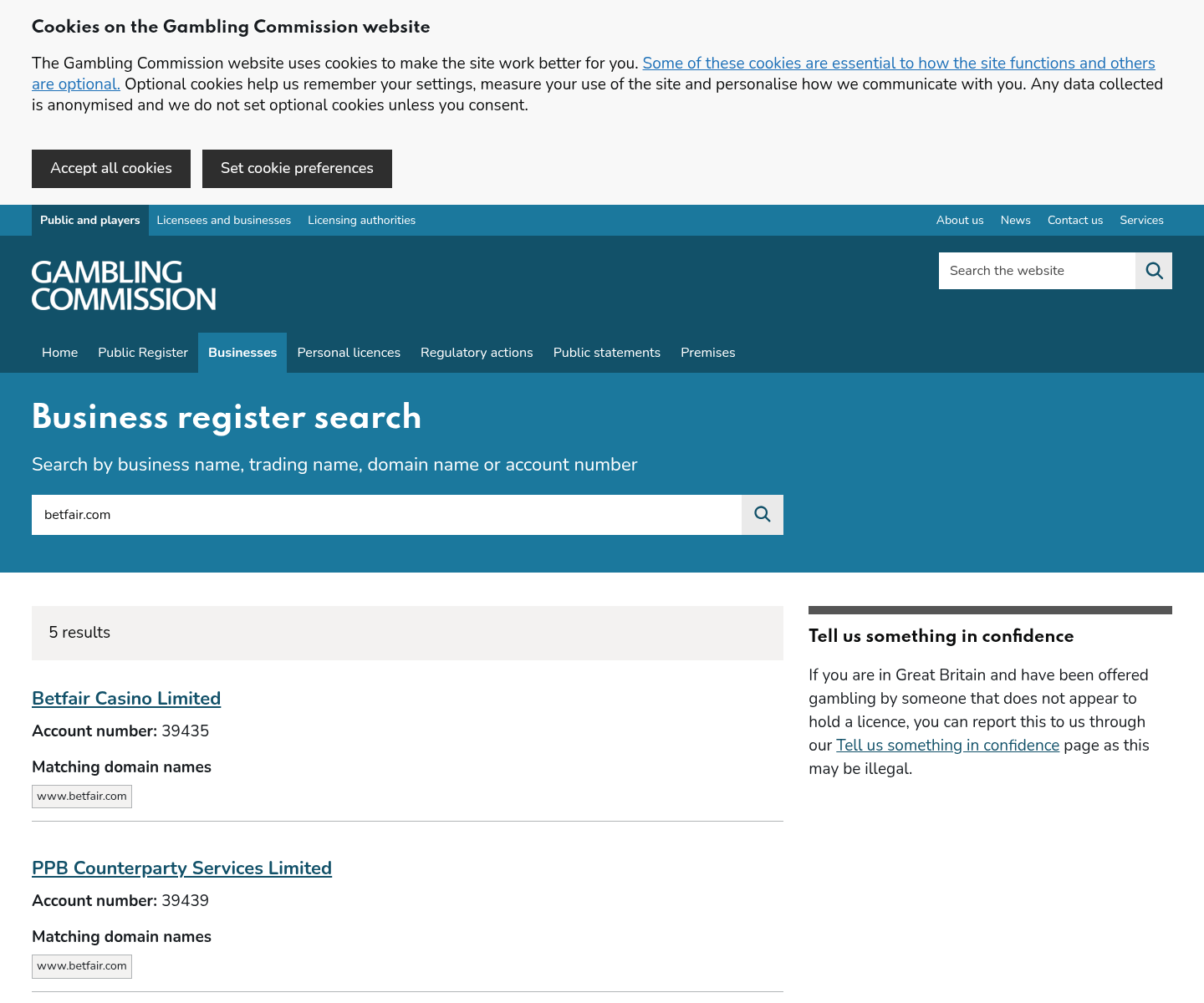
The complaint trail behind betfair.com was walked date by date rather than by reputation, and on 20 August 2026 it stops somewhere narrow and checkable. A Gambling Commission public register search on that exact domain returns Betfair Casino Limited in the result set, and the accepted record set holds no dated ruling, sanction notice or settled dispute against that company. An independent review-platform page was read the same day and logged as context only.
A green marker carries one meaning: current primary licensing evidence lines up with the precise domain and the precise company on the date recorded. It says nothing about payout speed, bonus conditions, account restrictions or how the complaints desk behaves, because no dated record of any of those things was accepted.
Complaint chronology as of 20 August 2026
All three accepted checks share one date, so there is no earlier baseline to compare against and no trend to describe. Two reading rules apply to what remains. A complaint stays an allegation until a competent body publishes a dated decision, and a review platform records sentiment rather than findings. Absence works the same way in reverse: no recorded adverse decision is not proof of a spotless history, only proof that none entered the set by the date shown.
| Date | Record | Ledger tier | Settles | Cannot settle |
|---|---|---|---|---|
| 2026-08-20 | Commission register search on the exact domain (src-039) | Primary | Domain appears with the named licensee | Payouts, disputes, service quality |
| 2026-08-20 | Independent review-platform page (src-041) | Logged primary check, contextual role | That a public sentiment page exists and was read | Licensing, safety, any named complaint |
| 2026-08-20 | Gambling Act 2005 contents (src-005) | Primary | The statute framing licensing in Great Britain | Anything specific to one licensee |
Host, licensee and licence account: the exact match test

Identity is matched at host level, not brand level. What counts is betfair.com in the address bar, because a licensing result attaches to a domain and a registered company rather than to a name printed on an advert, an app listing or an email footer. The dated search returned Betfair Casino Limited against that domain, with licence account UKGC 39435 recorded as a current remote entry.
Reproducing it takes about a minute in the Commission business register search: query the domain rather than the trading name, then confirm the domain in the result, the company attached to it, and a remote status that is current rather than lapsed or surrendered. A footer licence number that resolves to a different company or a different domain is not a formatting quirk; the mismatch is the result. The same routine sits behind the register-based licence checks.
| Field | Accepted record | Tier | Checked on |
|---|---|---|---|
| Exact domain assessed | betfair.com | Primary | 2026-08-20 |
| Licensee in the result set | Betfair Casino Limited | Primary | 2026-08-20 |
| Licence account | UKGC 39435, current remote record | Primary | 2026-08-20 |
| Licence expiry date | Not present in the accepted records | Unknown | not recorded |
| Verdict basis | Current primary licensing evidence | Primary | 2026-08-20 |
Legal position under the Gambling Act 2005
Remote gambling offered to consumers in Great Britain sits under the Gambling Act 2005, the statute that creates the licensing regime the Commission administers. The practical consequence is binary: a site is either covered by a current remote licence for the domain it serves, or it is not, and promotional wording does not alter that.
On the accepted evidence the operator behind the reviewed domain sits inside that framework as of 20 August 2026. What the statute cannot do is guarantee the outcome of one account. Licence conditions govern age and identity checks, marketing and dispute handling, while enforcement follows a documented regulatory process rather than a customer's timetable.
Scam or legit, on the evidence
On the question most readers actually mean, whether the domain is an unlicensed operation collecting deposits outside the system, the dated register match answers no for 20 August 2026. That rules out the most common and most expensive failure mode.
It does not stretch further. Slow payouts, restrictive bonus terms, accounts closed after verification and stalled complaints all occur at licensed brands, and none of them are visible in a register result. The marker is a floor rather than a ceiling, and it works best alongside your own dated records of each deposit, request and message.
Readers who have run the register check themselves and decided to proceed can use the routed link: See today's checked pick.
Payments: supported facts and open items
No deposit method, fee, limit or processing window is supported by the accepted records, so none is asserted. Cashier line-ups at licensed British brands change without notice, and a confident list assembled from memory would be worse than an honest gap.
A short routine covers it before money moves: read the cashier while logged in, capture the method list with the date visible, confirm the payment step stays inside the same domain family, and keep the confirmation reference for every transaction. A reference number with a timestamp is the part that survives a disagreement later, which is why the deposit and payout checks are built around records rather than impressions.
| Payment item | Status in the accepted records | Confirm it yourself by |
|---|---|---|
| Accepted deposit methods | No supported record | Dated capture of the logged-in cashier |
| Minimum deposit | No supported record | Cashier field limits and published terms |
| Deposit or withdrawal fees | No supported record | Dated copy of the terms in force |
| Account and transaction limits | No supported record | Account settings after registration |
| Deposit limit tools | No supported record | In-account safer gambling controls |
Withdrawals: no dated payout test exists
No withdrawal was attempted, so no payout speed is claimed. A payout test only counts when it carries the amount, the method, a timestamped request, a timestamped receipt and the verification state of the account at the time. Looser accounts are anecdotes.
Until such a record exists the honest reading is neutral rather than favourable or damning. The evidence is cheap to build: note the request time, check whether a pending or reversal window applies before funds clear, save the confirmation message, and record the date the money actually arrives. If a request is cancelled or reversed without explanation, that dated pair of captures is what any later escalation rests on.
Verification, KYC and account gates
Identity verification is a licensing consequence rather than a brand quirk, but the specific documents, thresholds and timings used by the operator are absent from the accepted records and stay listed as unknowns.
Preparation reduces friction. Register with a name and address that match your payment instrument, expect requests for photographic identity and proof of address, and keep a copy of everything uploaded with the date and channel. A freeze pending verification is not by itself evidence of misconduct on either side; the useful material is the timeline of what was asked for, what was sent, and how long each step took.
Escalation gates and the complaint route
Escalation runs in stages, and skipping one usually resets the clock. The operator's own complaints channel comes first, then the alternative dispute resolution provider named in the licensee's published terms, then the regulator, which supervises licence conduct rather than acting as a refund service for individual accounts.
The brand-specific detail, meaning the complaints address, the named ADR body and any published response window, is not in the accepted records, so confirm each in the licensee's own terms before filing. What travels well between stages is one clean bundle, and the complaint escalation route assumes you have kept it.
| Stage | What to send | Status in the accepted records |
|---|---|---|
| Operator complaints channel | Account reference, dated transaction list, captures | Contact route not documented |
| ADR provider named in the terms | Same bundle plus the operator's written reply | Provider not named in the records |
| Gambling Commission | Licence-conduct concerns rather than refund requests | Register search only, no adverse record |
| Your own file | Copies of everything sent, with dates intact | Reader-held, and the part you control |
Clone and lookalike checks
Clones copy artwork, never licensing. The cheap defence is to arrive by typing the domain or using a bookmark, then repeat the register search instead of trusting badge graphics, which are copied in seconds. Near-miss domains usually arrive through paid search placements or unsolicited messages, which is the pattern tracked in the clone and scam warnings.
| Check | Consistent with the accepted record | Warning sign |
|---|---|---|
| Address bar host | betfair.com exactly, over HTTPS | Added hyphens, words or a different ending |
| Register search by domain | Result names the licensed company | No result, or a different company |
| Footer licensing text | Company name matches the register result | Number that resolves elsewhere |
| Payment step host | Stays within the same domain family | Redirect to an unrelated host |
| How you arrived | Typed address or saved bookmark | Link from an advert or cold message |
Unresolved evidence and residual risk
The gaps matter as much as the match. Licence expiry is blank in the packet, so no end date is claimed. There is no accepted record of bonus terms, game suppliers, territory restrictions, support response times, account-closure practice, or a single dated complaint outcome. The independent review-platform page was read on 20 August 2026 and logged as context: it is neither sampled nor weighted, and it can neither support nor refute a licensing conclusion.

Residual risks are ordinary rather than exotic. A licence position can change between checks, terms can be revised after registration, and a verification request tends to arrive at the first withdrawal. None of that is an allegation against the operator; it describes the conditions any licensed account runs under. Where gambling has stopped feeling optional, that comes before any paperwork, and the immediate help routes are the first step.
Method, re-checks and corrections
Every claim above traces to a source identifier, a tier and a date, and anything without that chain was left out rather than softened into an implication. Primary records carry the verdict, operator statements would be labelled as statements, and user sentiment stays contextual, as set out in the review methodology and editorial policy.
The marker is dated deliberately. It reflects the register result on 20 August 2026 and nothing later: a change in licence status, a published sanction or a documented dispute outcome would move it, and the amber default returns as soon as primary support stops being current. Corrections are held to the same standard, so send a dated primary record, a resolvable reference and the specific claim to be changed through corrections and contact. Comparable dossiers sit in the casino index.
Frequently asked questions
Is Betfair licensed to offer casino games in Great Britain?
On 20 August 2026 a Gambling Commission register search on the exact domain returned Betfair Casino Limited, with licence account UKGC 39435 recorded as a current remote entry. The finding is dated, so re-run the search before relying on it.
Does a green marker mean the operator is safe to use?
It means current primary licensing evidence matches the domain and the company. Payout speed, bonus conditions and complaint handling are not covered, because no dated record of them was accepted.
Which company stands behind betfair.com?
The dated register capture names Betfair Casino Limited in the result set for that domain. A footer or advert naming a different company for the same domain is a mismatch worth resolving before depositing.
Are there dated complaint rulings against the licensee?
None were accepted into the record set. That is not the same as a clean history: it means no competent-body decision was verified and dated, so any complaint circulating elsewhere remains an allegation.
Has a withdrawal been tested?
No. Without a timestamped request, a timestamped receipt, the amount, the method and the account's verification state, no payout claim would be supportable, so withdrawal performance is recorded as unknown.
How can I check the domain myself before depositing?
Type the address rather than following a link, search the Commission business register by domain, confirm the company name and remote status agree with the result, and keep a dated capture of what you saw.