Betfred UK evidence dossier: licence, KYC and withdrawals
A withdrawal can stall when the name on a payment method does not match the identity document supplied for verification. That mismatch does not, by itself, establish fraud or misconduct. It does create a practical problem: the account holder, payment owner and submitted documents may need to be reconciled before funds can move.
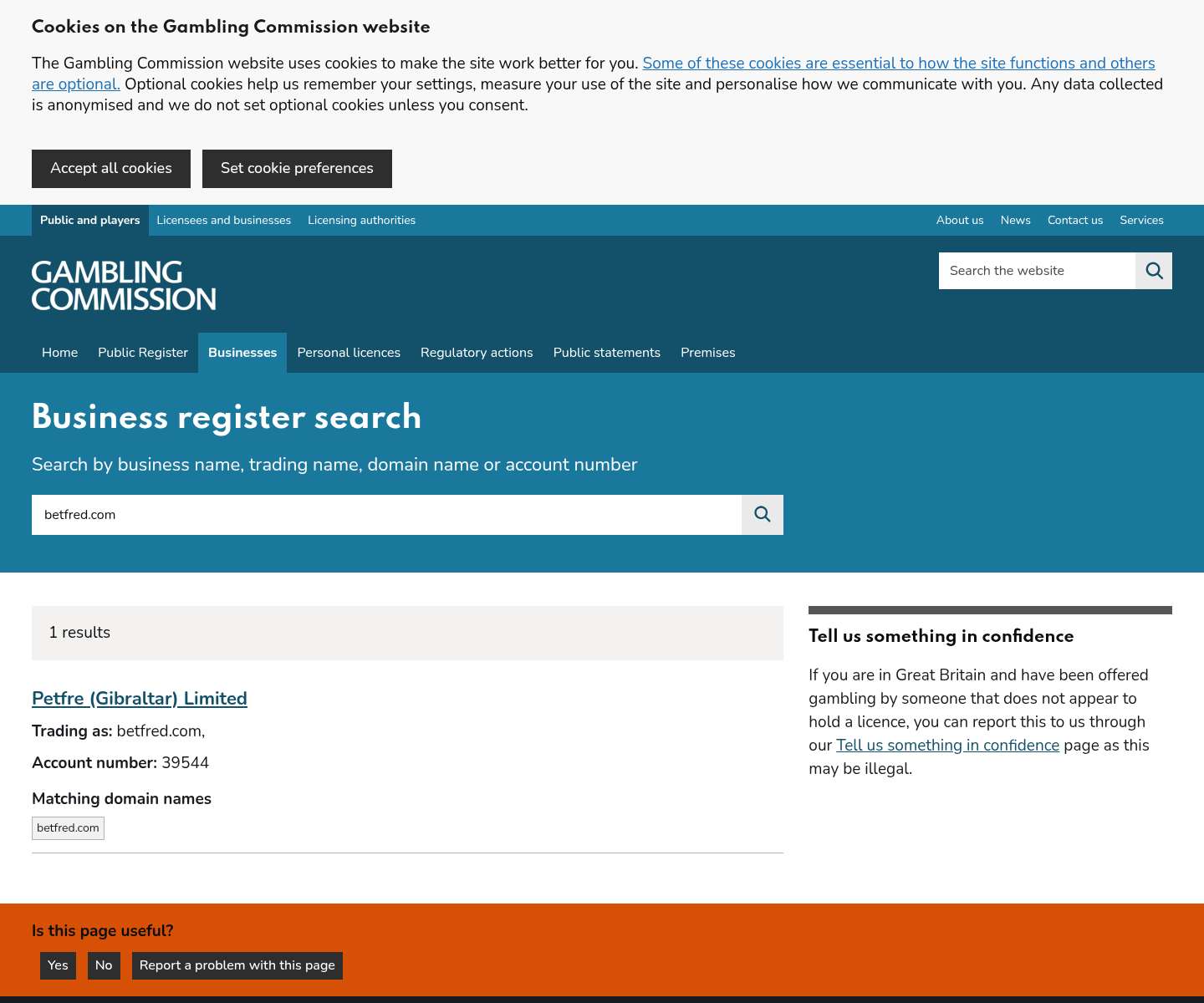
For Betfred United Kingdom customers, the strongest available identity check starts with the exact host. A dated Gambling Commission register search associates betfred.com with Petfre (Gibraltar) Limited under UKGC account 39544. That precise host–operator match supports a green signal for the licensed identity reviewed here. It does not guarantee that every transaction, verification request or complaint will be resolved in a customer’s favour.
Legal identity: host, operator and licence
The legal conclusion is narrow but useful: the exact domain supplied in the evidence packet appears in the Gambling Commission result set with the named operator. The dated public-register search was checked on 20 August 2026. Its result supports the proposition that the reviewed host is connected to a current remote operating record under account 39544.
| Identity point | Verified value | Practical meaning |
|---|---|---|
| Exact host | betfred.com | The spelling and top-level domain should match before login or payment |
| Named operator | Petfre (Gibraltar) Limited | This is the entity returned with the host in the dated register search |
| Regulatory record | UKGC account 39544 | A current remote record was checked on 20 August 2026 |
| Licence expiry | Not supplied | No expiry date should be inferred |
The relevant statutory background is the Gambling Act 2005, identified in the packet as the principal gambling statute for Great Britain. The record supports “legal for the reviewed GB host and operator identity”, not a universal claim covering similarly named domains, overseas access or every product a visitor might encounter.
Scam or legitimate: what the green signal means
Betfred receives a green signal because current primary evidence supports the precise domain–entity relationship. The result answers the core identity question: the supplied host is not merely using a familiar trading name without regulatory support in the packet. It is returned alongside Petfre (Gibraltar) Limited in the dated regulator search.
A green signal is not a promise of trouble-free withdrawals, instant support or favourable dispute outcomes. It also cannot authenticate an email, advert, social-media account, mobile download or lookalike address. A genuine operator can be impersonated, and a licensed service can still receive complaints. The safe conclusion is therefore specific: the reviewed host/operator combination has current primary support; individual communications and payment requests still require separate checks.
| Question | Evidence-led answer | Limit |
|---|---|---|
| Is the exact host regulator-linked? | Yes, in the dated result set | Applies to betfred.com as checked |
| Is the named operator supported? | Yes, Petfre (Gibraltar) Limited | No other legal entity was supplied |
| Is every complaint disproved? | No | Licensing does not decide individual disputes |
| Are all payment methods verified? | Unknown | No operator payment schedule was supplied |
| Was a withdrawal tested? | No evidence of a test | Processing speed and outcome cannot be claimed |
Account ownership and KYC mismatch checks
The opening identity-document mismatch should be handled as a reconciliation exercise, not as proof that either side has acted improperly. Begin by comparing the account name, date of birth and residential details with the document submitted. Then compare the payment instrument’s account-holder name. Differences caused by abbreviations, a changed surname, a joint account, an expired document or an outdated address may require explanation and evidence.
Do not send extra documents merely because an unsolicited message demands them. First enter the service through the independently checked host, inspect the request inside the authenticated account and use the support route presented there. Redact information only where the operator confirms that redaction is acceptable; otherwise an altered image may be rejected. Keep the original file, the submitted version and the submission time.
| KYC item | What to compare | Useful record to retain |
|---|---|---|
| Identity document | Full name, birth date, validity and image clarity | Copy of the submitted file and submission receipt |
| Address evidence | Address wording and document date | Original statement or bill and upload confirmation |
| Payment ownership | Name on bank, card or wallet record | Relevant statement excerpt, with unrelated activity protected where accepted |
| Account profile | Registered personal details | Dated screenshot or exported account information |
| Source-of-funds request | Exact period and documents requested | Request text, response and file list |
The evidence packet does not describe the operator’s document list, retention period, review deadline or source-of-funds thresholds. Those points remain unknown and should not be guessed from another casino’s procedures.
Payments and payment-name checks
No verified payment-method list, deposit limits, fee schedule or processing timetable was supplied. It would therefore be unsafe to state that a particular card, bank transfer or wallet is accepted. The useful check is procedural: confirm the available methods while signed in on the verified host and preserve the terms shown before authorising a deposit.
Using a payment method held in another person’s name can create an ownership question. Even where the transaction initially succeeds, later verification may require evidence linking the account holder to the funds. Customers should avoid assuming that acceptance at deposit stage means the method has passed every ownership or withdrawal check.
Record the method label, amount, date, transaction reference and any displayed fee or limit. If a deposit is missing, distinguish between a bank authorisation, a completed debit and a casino-account credit. These are different stages and may require different evidence. The broader payment-check guidance explains how to organise those records without claiming a method is available here.
Withdrawals: evidence before conclusions
There is no supplied withdrawal test. No verified minimum, maximum, fee, pending period or payout speed is available. Accordingly, neither “fast withdrawals” nor “withdrawal scam” is supported by this packet. A delayed payment needs a transaction-specific chronology.
Build that chronology from the withdrawal request time, status changes, verification requests, responses, cancellation or reversal events and the eventual payment reference. If the account interface shows a reason, preserve the exact wording rather than paraphrasing it. Where a document is rejected, ask which field, format or eligibility rule caused the rejection and what acceptable replacement is required.
| Withdrawal stage | Evidence to save | Question to ask |
|---|---|---|
| Request submitted | Amount, method, timestamp and reference | Was the request accepted into pending status? |
| Review begins | Status screenshot and any notification | Is KYC, payment ownership or another check outstanding? |
| Documents requested | Complete request wording | Which document and date range will satisfy it? |
| Status changes | Dated before-and-after captures | Was the request cancelled, reversed or approved, and by whom? |
| Payment sent | Operator reference and receiving-account record | What trace information exists if funds do not arrive? |
Do not open repeated withdrawals to test the system while a dispute is active; that can complicate the record. If gambling is becoming difficult to control, use responsible-gambling support rather than treating a payment dispute as a reason to continue depositing.
Complaint packet and escalation route
A useful complaint is concise, chronological and tied to a requested remedy. State the account identifier without publishing sensitive credentials, identify the disputed transaction, list important dates and attach only relevant evidence. Separate facts from interpretations: “the status changed from pending to cancelled at 14:10” is more useful than an unsupported accusation.
Ask the operator to confirm its final position and the applicable escalation route. The packet does not identify a particular alternative dispute resolution provider, complaint deadline or support address, so none should be invented. The internal complaints guide can be used to structure the file.
Include: a one-sentence issue summary; transaction references; the KYC request and response; copies of material status messages; the remedy sought; and a reasonable request for a written decision. Exclude passwords, full card numbers and unrelated financial history. Keep an unedited master copy of every record even if a reduced copy is submitted.
Clone and impersonation checks
A copied logo or familiar colour scheme proves nothing about the host. Before entering credentials, read the address character by character and confirm it is betfred.com, not a longer address that merely contains the brand name. Check for substituted letters, added hyphens, unusual subdomains and links shortened so the destination is hidden.
The supplied logo is an identification aid, not regulatory evidence. The register capture carries the evidential weight for the host/operator link. An unsolicited caller or message should not be trusted because it cites account 39544; licence details are public and can be copied by an impersonator.
Warning signs include pressure to move a conversation to a private messaging app, a request for cryptocurrency to release a withdrawal, remote-access software instructions, or demands for a “tax” paid to a personal account. None of those scenarios is established against the reviewed operator here. They are practical clone checks. Further warning patterns are listed in scam warnings.
User context, risks and privacy limits
A review-platform page was checked on 20 August 2026 for contextual user signals. User reviews may identify themes worth testing against account records, but they do not prove licensing status, a complaint, a general payout rate or wrongdoing. Individual accounts can be incomplete, mistaken or impossible to authenticate from the supplied material.

The main evidenced risk is not an official adverse finding but overreading limited material. The packet verifies identity and regulatory association; it does not verify service quality, complaint volume, payment performance or KYC handling in a particular case. Personal documents also create privacy exposure. Submit them only through an authenticated channel, confirm why each item is required and retain a record of what was sent. General handling considerations are available in the privacy information.
Evidence chronology, method and correction path
The assessment uses claim-level separation. The Gambling Commission result is primary evidence for the exact host and operator association. The legislation record supplies statutory context. The review-platform capture is contextual only, despite being a dated source record; it cannot replace regulator evidence or establish an individual allegation.
| Date checked | Record | Supported use | Not supported |
|---|---|---|---|
| 20 August 2026 | Gambling Commission search | Host, operator and current account association | Payment performance or complaint outcome |
| 20 August 2026 | Gambling Act 2005 record | Principal GB statutory context | Case-specific legal advice |
| 20 August 2026 | Independent review platform | Topics that may merit checking | Licence, safety or proven misconduct |
The method gives the green signal only to the precise supported identity. Unknown licence expiry, payment methods, withdrawal timings, KYC deadlines and complaint destination remain unknown. The full standards are set out in the methodology.
Corrections should identify the disputed sentence, provide a dated primary record where possible and explain the exact change requested. Use the corrections contact. A later regulator update, operator-entity change or official adverse record could alter the signal.
For readers who have independently confirmed the host and accept the unresolved payment and KYC limits, See today's checked pick. Gambling involves financial risk; set limits and do not use borrowed money.
Frequently asked questions
Is Betfred legal in the United Kingdom?
The checked Gambling Commission result associates betfred.com with Petfre (Gibraltar) Limited under UKGC account 39544. That supports the reviewed host’s licensed identity for Great Britain as at 20 August 2026, but it does not authenticate lookalike domains or determine access rules outside the reviewed market.
Is Betfred a scam?
The supplied primary record supports the exact host and operator match, so the evidence does not support describing the reviewed service as a scam. This conclusion does not guarantee every payment or complaint outcome, and impersonation sites must still be excluded.
Why might identity verification delay a withdrawal?
A mismatch between the casino account, identity document and payment-owner name may require reconciliation. The supplied packet does not state Betfred’s review deadlines or document rules, so preserve the request, response, files and status changes and ask for the exact outstanding requirement.
Which payment methods and withdrawal times are verified?
None are verified in the supplied evidence. No accepted-method list, fee schedule, limits or withdrawal test was provided. Check the options and terms inside the authenticated account and retain the transaction details shown there.
How should I complain about a payment or KYC decision?
Prepare a dated chronology, transaction references, the exact request and response, relevant status captures and the remedy sought. Ask the operator for a written final position and its applicable escalation route; no specific dispute provider was verified in the packet.
What proves that I am using the real host?
Match the address exactly to betfred.com and verify the operator relationship against the dated Gambling Commission record. A logo, advert, message or copied licence number is not enough because those elements can be reproduced by an impersonator.