Casumo UK review: licence, payments and checks
A delayed bank transfer can make any casino decision feel urgent. If money has left your account but has not arrived, do not immediately try a second payment or assume that the service has disappeared. Record the amount, time, payment route and reference, then compare those details with the transaction history and your bank’s pending-payment information. The evidence below concerns the precise host casumo.com, not every website using a similar name.

Executive finding: what the dated record supports
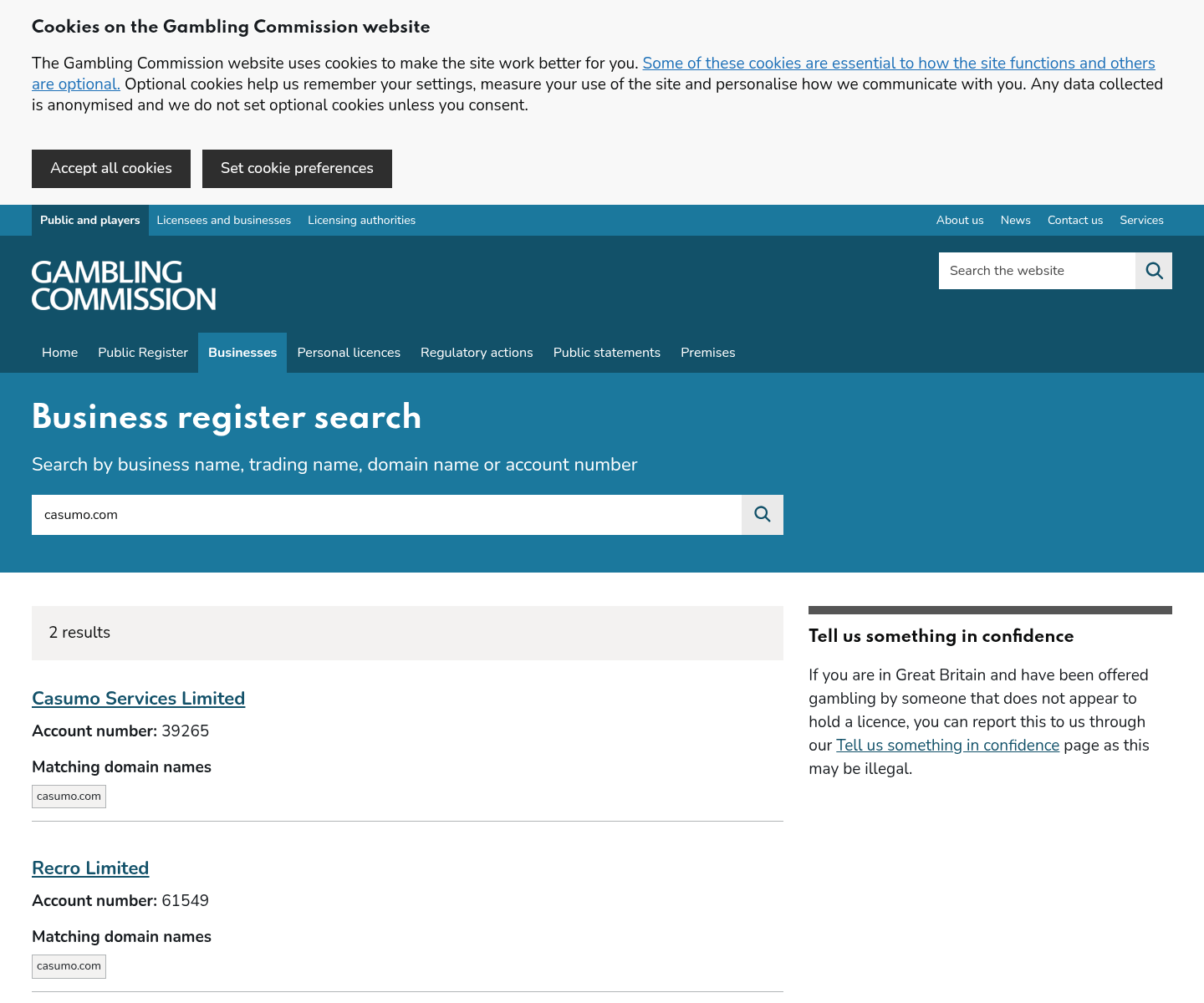
The current evidence supports a green signal for the exact domain and operator pairing checked on 20 August 2026. The UK Gambling Commission register search returned casumo.com with Recro Limited in the result set. The UKGC account identified in the supplied licence description is 61549, and the current remote record was checked on that date.
That is a narrow conclusion. It supports a current primary-record match between the named host and operator in the supplied register capture. It does not prove that every advert, mirror, mobile application, payment instruction or customer-service message using the name belongs to that host. It also does not establish a successful withdrawal, a particular payment method, a processing time, a bonus outcome or a personal gambling experience.
| Check | Supplied result | Practical meaning |
|---|---|---|
| Exact host | casumo.com | Compare the address character by character before signing in or paying. |
| Named operator | Recro Limited | The operator name is the reference point for licence reconciliation. |
| UKGC record | Account 61549 | The dated primary record supports the stated host/operator match. |
| Record date | 20 August 2026 | Licence status is time-sensitive and should be rechecked before relying on it. |
| Expiry | Not supplied | No expiry date should be inferred from the packet. |
Host, operator and licence reconciliation
A useful reconciliation has three separate fields: the address you intend to use, the legal entity shown in the regulatory record and the account number associated with that record. Here, those fields are casumo.com, Recro Limited and UKGC account 61549. Keeping them separate helps prevent a familiar brand label from being treated as proof of a connected domain.
The primary register capture is the strongest supplied evidence because it is a regulator record rather than an operator description or an individual report. The result set is described as returning casumo.com with Recro Limited. It does not supply an expiry date, a full licence history or a guarantee that an unlisted variation of the domain is authorised. Those remain limits rather than gaps to fill with assumptions.
For a fresh check, start at the regulator’s public-register result for the precise domain and compare the displayed host, entity and account number. The dated UKGC register search is the supplied primary reference. A search-result match is useful only when the spelling and domain are exact; a logo, colour scheme or copied footer is not an equivalent check.
Is it legal in the United Kingdom?
The evidence supports the cautious answer that the precise host is associated with a current UKGC remote record checked on 20 August 2026. The underlying legal framework is the Gambling Act 2005, identified in the supplied packet as the principal Great Britain gambling statute. That framework and a current register entry are relevant to legality, but this dossier does not give legal advice or make claims about every possible use, promotion or transaction.
The correct wording is therefore narrower than “everything is safe”. A current primary record supports the host/operator/licence relationship at the date checked. It does not remove ordinary gambling risk, guarantee account access, settle a payment dispute or confirm that a third-party link is genuine. It also does not provide an expiry date because none was supplied.
The Gambling Act 2005 text is included as the statutory context. It should not be read as evidence of a particular customer outcome. If the domain, entity or account number differs from the record, pause and reconcile the discrepancy rather than relying on the green signal shown here.
What the green signal does—and does not—mean
The signal is green because current primary evidence supports the precise domain/entity relationship. Green is not a prediction of profit, a promise of uninterrupted service or an endorsement of a payment decision. It is a classification of the evidence available for one dated check.
| Question | Supported answer | Boundary |
|---|---|---|
| Is the exact host matched in the supplied primary record? | Yes, casumo.com appears with Recro Limited. | The result was checked on 20 August 2026. |
| Is account 61549 supplied for the remote record? | Yes. | No expiry date was supplied. |
| Does the packet prove a withdrawal was completed? | No. | No withdrawal test or customer transaction record was supplied. |
| Does the packet prove every similar domain is genuine? | No. | Clone checks must be performed separately. |
| Does user context establish a complaint or breach? | No. | User context is not proof of licensing, safety or a complaint. |
This distinction matters when a partial transfer is delayed. A valid-looking host does not tell the bank whether a particular payment is pending, reversed, blocked or misdirected. Those facts must come from the transaction record and the relevant payment provider.
Payment checks before a deposit
Before sending funds, note the exact domain in the browser address bar and avoid payment instructions received through an unexpected message. Check the recipient description displayed by the bank, keep the payment reference and use an amount that you can afford to lose. Do not treat a successful deposit as evidence that a later withdrawal will be immediate.
A bank reconciliation should begin with the account statement, not with a promise on a banner. Match the date, amount, currency, reference and status. A “pending” entry may require bank action or time to settle; a reversed entry needs different handling from a completed transfer. If the bank shows completion but the balance has not updated, ask the bank to trace the transaction and keep its case number.
| Payment event | Record to retain | Next practical step |
|---|---|---|
| Pending | Timestamp, amount and pending reference | Ask the bank whether it is authorised, held or awaiting settlement. |
| Completed by bank | Confirmation and recipient details | Compare it with the account transaction history and contact support through the verified host. |
| Reversed or rejected | Decline or reversal code | Do not repeat the payment until the reason is understood. |
| Unknown recipient | Full statement description | Contact the bank promptly and preserve screenshots or statements. |
No payment method, deposit limit, fee, currency or processing time was supplied in the verified packet. They must not be presented as established characteristics of the service.
Withdrawals: a careful process for missing funds
There is no supplied withdrawal test, so no completion time, success rate or operational outcome can be stated. If a withdrawal is delayed, first record the request date, amount, selected destination and status shown in the account. Do not submit duplicate requests merely because the first appears slow; duplication can make reconciliation harder.
Next, compare the destination details with the verified account information and ask support for a written explanation of the status. If the bank has not received the funds, request a trace using the payment reference. If the bank received and returned them, obtain the return reason. Keep the conversation, case number and any request for additional documents.
| Withdrawal evidence | What it can establish | What it cannot establish alone |
|---|---|---|
| Account request timestamp | When the request was submitted | That the bank received the funds |
| Status displayed in the account | The service’s recorded stage | Why a delay occurred |
| Bank trace or statement | Whether the bank received, held or returned a payment | That the account request was correctly processed |
| Written support response | The explanation given by the operator | That the explanation resolves the dispute |
Do not publish a withdrawal anecdote as a general result. The packet contains no dated withdrawal outcome and therefore leaves this area open.
KYC and account verification
Know-your-customer requirements are another important unknown. The supplied records do not state which documents may be requested, when checks occur, how long verification takes or what happens when a document is rejected. Do not assume that a deposit, a successful login or a register match means an account has already passed identity checks.
Use only the account’s verified support route when documents are requested. Check that the destination is the exact host, avoid sending identity documents in response to an unverified message and retain a note of what was requested and when. If a document is rejected, ask for the specific deficiency rather than repeatedly uploading altered copies.
The evidence supports no claim about age checks, address checks, source-of-funds checks, document retention, verification deadlines or account restrictions. Those matters require the applicable terms and a dated account-specific response. They should be treated as unresolved until documented.
Complaint route and bank escalation
A delayed transfer has two potentially different tracks. The first is an account or withdrawal complaint directed to the operator through its verified support channel. The second is a payment dispute or suspected misdirection raised with the bank. Keeping them separate prevents a bank investigation from being mistaken for a finding about the operator.
Start a written chronology containing the domain used, operator name, account number, transaction reference, dates, amounts, status messages and support case numbers. Ask for a clear response to one issue at a time: whether the payment was received, whether a withdrawal was approved or rejected, what document is outstanding, or why a transaction was returned. If the bank suspects fraud or an unauthorised payment, follow its urgent reporting process without waiting for an operator reply.
| Situation | Primary contact | Information to provide |
|---|---|---|
| Deposit missing from account | Bank and verified account support | Payment reference, amount, date and statement status |
| Withdrawal not received | Verified account support, then bank trace | Request timestamp, destination and bank statement |
| Payment sent to an unexpected recipient | Bank immediately | Full recipient description and authorisation details |
| Complaint unresolved | Follow the documented complaint route | Chronology, case numbers and copies of responses |
For general complaint preparation, the internal complaints guidance is available. It does not replace the bank’s urgent process for suspected unauthorised payments.
Clone and impersonation checks
A clone check is more than recognising the name. Type or verify the domain carefully, inspect the security certificate and compare the operator and account details with the regulator record. Be suspicious of altered spelling, extra hyphens, unfamiliar top-level domains, urgent payment requests, links that redirect through unrelated addresses and messages asking for passwords or identity documents.
The supplied logo is an identification aid, not regulatory evidence. A copied logo can appear on an unrelated website. Likewise, a search advertisement, social-media profile or review page does not establish that a destination is the authorised host. If an address does not reconcile to casumo.com and Recro Limited, stop before entering credentials or transferring money.
Use the internal licence-checking guide and scam warnings for a repeatable comparison. The precise domain should remain the controlling detail. Never substitute a similar spelling simply because its design appears familiar.
User reports and what remains unknown
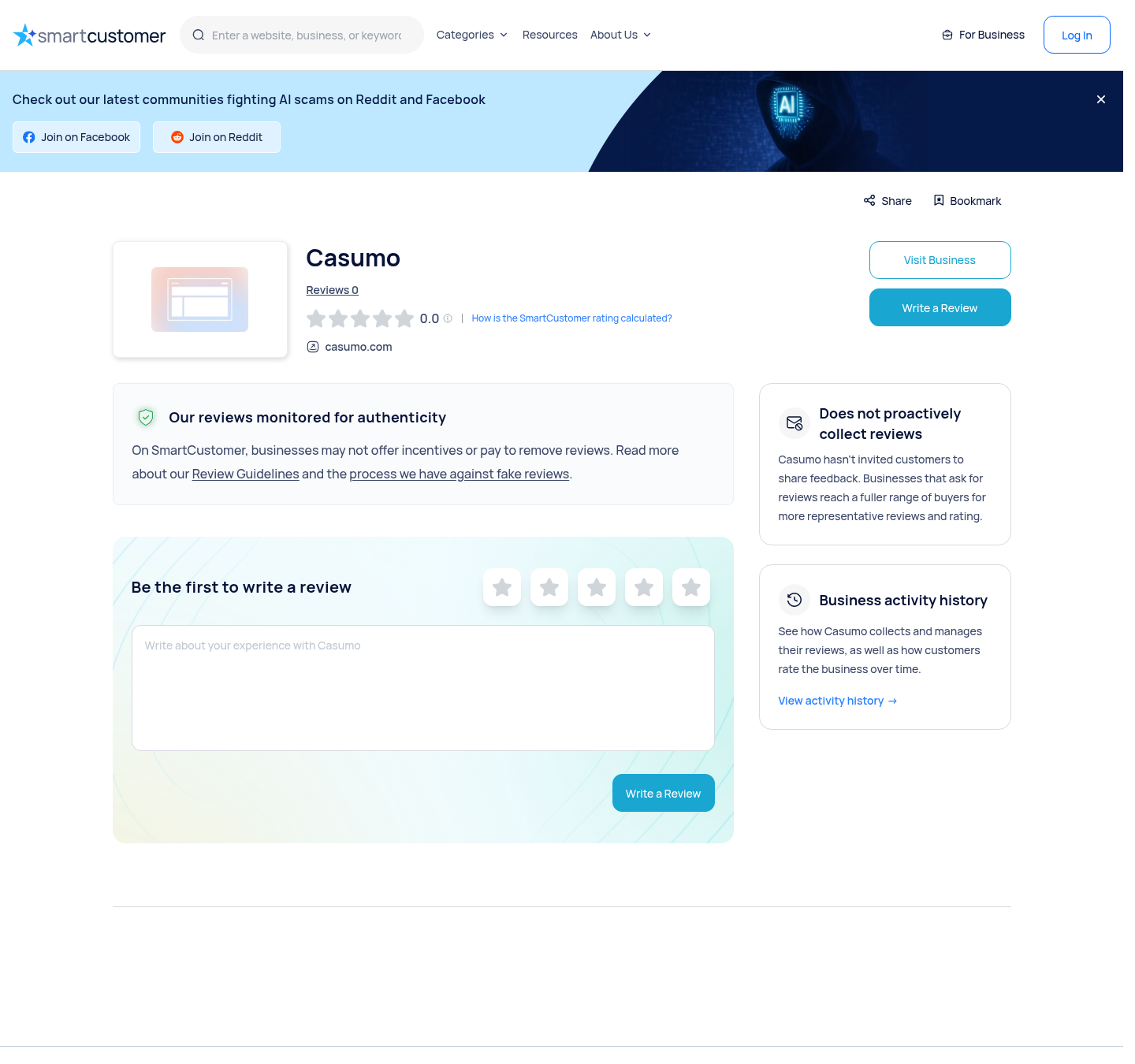
The supplied review-platform record is contextual only. It was checked on 20 August 2026, but the packet expressly says that its content or absence of content is not proof of licensing, safety or a complaint. Individual reports can help identify questions to investigate, yet they do not establish that an allegation occurred, that the operator caused it or that it represents typical treatment.
The dated review-platform context should therefore be read as a source of signals for further checking, not as a verdict. No complaint, quote, withdrawal result or personal experience has been adopted from it.
| Evidence category | Included conclusion | Not included conclusion |
|---|---|---|
| Regulator record | Host and operator appear together in the supplied result set. | Universal safety or future availability. |
| Statute | Gambling Act 2005 supplies legal context. | A ruling on an individual dispute. |
| User-context page | A dated contextual source was checked. | Proof of a complaint, breach or typical outcome. |
| Transaction evidence | None supplied. | Payment or withdrawal performance. |
Unknowns include payment rails, withdrawal timing, KYC practice, complaint outcome, licence expiry and any account-specific restriction. Stating these unknowns is part of an accurate risk assessment, not evidence of wrongdoing.
Evidence chronology and method
The available chronology has one checking date: 20 August 2026. On that date, the primary register search was recorded as returning casumo.com with Recro Limited, with UKGC account 61549 identified for the current remote record. The review-platform page was also checked for context. The Gambling Act 2005 was recorded as the statutory background on the same date.
The method is deliberately compartmentalised. First, reconcile the exact host with the named operator and account number. Second, classify the source: a regulator record is primary, a statute supplies legal context, and a review-platform page is user context. Third, state only what each source can support. Fourth, list material unknowns instead of filling them with general casino expectations. Finally, preserve dates so a later check can show whether the position has changed.
For further detail, see the internal payment checks and methodology routes. The green signal belongs to this evidence snapshot and should be revisited if the domain, operator or account details change.
Correction path and responsible use
If you identify a spelling mismatch, a changed register result or a dated primary record that materially alters the conclusion, preserve the source URL, access date, displayed host, operator and account number. Send the correction through contact and corrections, explaining which statement is affected and supplying the new dated evidence. A correction request should distinguish a factual change from an allegation or an individual payment experience.
If gambling is causing financial or personal difficulty, stop and seek appropriate support rather than trying to recover a delayed payment through further play. The internal responsible gambling guidance, self-exclusion information and urgent help routes provide separate support information. A licence match does not make gambling risk-free, and no evidence here supports a promise of profit or a guaranteed resolution.
If, after checking the exact host and the relevant terms, you choose to continue, use the supplied See today's checked pick and verify the address before entering credentials. This link is a navigation option, not a claim about payment speed, withdrawal success or suitability.
FAQ
Is Casumo legal in the UK?
The supplied evidence supports a current UKGC remote record for casumo.com with Recro Limited, account 61549, checked on 20 August 2026. It does not provide legal advice or prove every related domain or transaction is authorised.
Who operates casumo.com?
The supplied primary register result returns casumo.com with Recro Limited. The pairing should be checked again if the domain, operator name or account number changes.
Does the evidence prove withdrawals work?
No. The verified packet contains no withdrawal test, completed transaction or dated customer outcome, so no withdrawal speed or success claim can be made.
What should I do if a bank transfer is delayed?
Record the amount, time, reference and status, ask the bank to trace the payment where appropriate, and contact support through the exact verified host. Do not repeat the payment until the first transaction is understood.
Does a review-platform complaint prove a scam?
No. The supplied review-platform page is user context only. Its content or absence of content is not proof of licensing, safety or a complaint.
How can I check for a clone?
Compare the address character by character with casumo.com, reconcile Recro Limited and UKGC account 61549 in the regulator record, and treat different spellings, redirects or unexpected payment requests as warning signs.
What licence expiry date was verified?
No licence expiry date was supplied in the verified packet, so none should be inferred.