NetBet United Kingdom: licence, host and dispute evidence
A disputed casino round is difficult to investigate without its round ID, session ID or exact timestamp. For a NetBet account, preserve that identifier before debating whether a balance change, interrupted game or settlement was correct. Pair it with the game name, displayed stake, opening and closing balances, device time and any message shown. Those records do not decide a dispute, but they give the operator a specific event to reconstruct.
The regulatory starting point is clearer. A UK Gambling Commission register search checked on 20 August 2026 returned netbet.co.uk with Netbet Enterprises Limited. UKGC account 39170 had a current remote record on that date. That exact host–operator match supports a green signal for the identified British service; it does not guarantee every transaction, game outcome or complaint decision.

Verdict: legitimate licensed host, not a blanket safety promise
For the precise domain reviewed, the available primary evidence supports a legitimate licensed operation in Great Britain. The match has three parts: the host is netbet.co.uk, the named business is Netbet Enterprises Limited, and the current remote record is associated with UKGC account 39170. Readers can compare that result with the dated UK Gambling Commission register search.
| Question | Evidence-led answer | Important boundary |
|---|---|---|
| Is the exact UK host found in the register result? | Yes, in the capture checked 20 August 2026. | A similar-looking host is not covered. |
| Does the operator name match? | Yes: Netbet Enterprises Limited. | Trading names and company names need not look identical. |
| Is a current remote record documented? | Yes, under account 39170 on the check date. | Status can change after the dated check. |
| Does this prove a disputed round was settled correctly? | No. | Round-level evidence must be examined separately. |
Calling the documented host a scam would conflict with the current primary record supplied here. Calling every experience risk-free would also go beyond it. A licence establishes regulatory identity and status at a point in time; it is not advance approval of an individual withdrawal, verification request, bonus decision or technical incident. Our licence-checking guide explains why the host, legal entity and current status must be checked together.
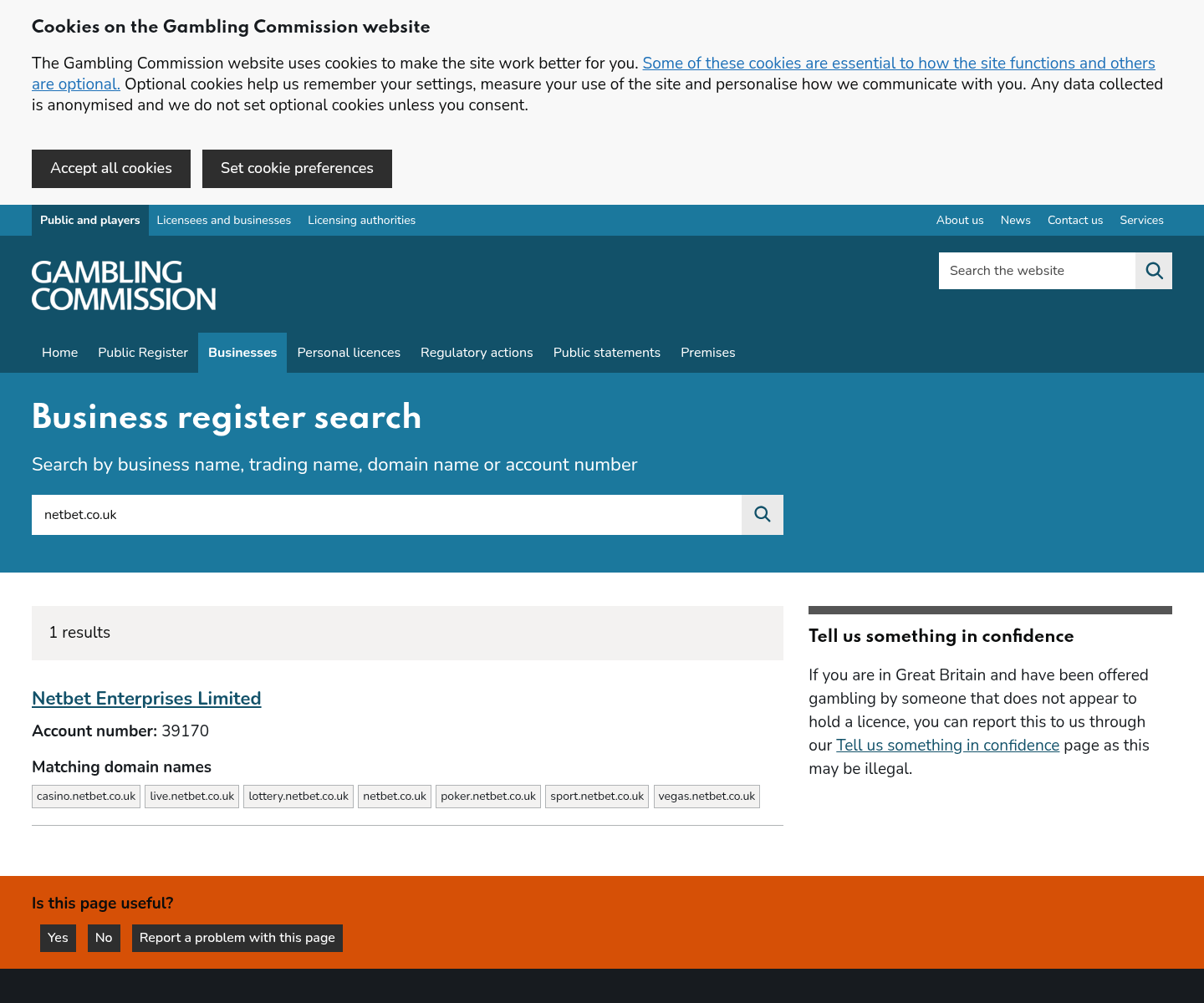
Exact host, operator and licence match
The useful verification unit is not the brand name alone. It is the complete chain linking the web address, operating company and regulator record. In this case, the supplied chain is netbet.co.uk → Netbet Enterprises Limited → UKGC account 39170. A spelling variation, added word, different suffix or unfamiliar subdomain can break that chain and should be treated as unverified until independently matched.
| Identity field | Verified packet | What to inspect yourself |
|---|---|---|
| Host | netbet.co.uk | Read the address bar character by character. |
| Legal operator | Netbet Enterprises Limited | Compare the account footer and formal terms with the register. |
| Regulator reference | UKGC account 39170 | Open the register independently and inspect current permissions. |
| Record date | 20 August 2026 | Repeat the check if relying on it later. |
| Licence expiry | Not supplied | Do not invent an expiry date or assume permanence. |
The packet does not provide an expiry date. It therefore supports only the current-record statement made on the check date. The governing legal context is the Gambling Act 2005, identified in the evidence as the principal Great Britain gambling statute. That statute link gives legal context, but it does not resolve a private account dispute or replace the regulator’s current business record.
A green signal applies narrowly to the verified identity and current primary evidence. It should not be copied to another country-specific host, app download, advert, mirror or social-media account merely because the same name or visual style appears there.
Reconstructing a disputed round or session
Begin with the smallest event that can be uniquely identified. Record the round ID if the game history exposes one; otherwise preserve the session ID, game title and a narrow time window. Use the account’s displayed time zone if known, and also note the local time on the device. A screenshot can preserve what was displayed, but the underlying account and game records are more useful for reconstruction than an isolated image.
| Record to preserve | Why it matters | Weak substitute to avoid |
|---|---|---|
| Round or session ID | Gives support a unique database reference. | “It happened last night.” |
| Game title and provider shown | Narrows the ledger and technical logs. | A cropped image with no game name. |
| Stake and balance before/after | Tests the claimed financial effect. | Remembered balance estimates. |
| Exact timestamp and time zone | Helps align account, game and payment logs. | An undated screenshot. |
| Error text or interruption sequence | Distinguishes display, connection and settlement issues. | A general claim that the game froze. |
| Support case number | Connects later replies to the original report. | Starting a new conversation each time. |
Do not repeatedly replay the same game to “prove” a fault; that can create unrelated transactions and blur the disputed event. Instead, stop, export or photograph the visible history, and write a short chronology while details are fresh. State the remedy requested—an explanation, ledger correction or release of a settled balance—without asserting a technical cause that the available evidence cannot establish.
The operator may hold server-side records unavailable to the customer. Ask for the result recorded for the identified round, the time it settled, the stake and return logged, and an explanation of any difference from the account history. Preserve the response in its original form rather than relying on a paraphrase.
Account history and transaction evidence
A round history answers a different question from a cashier history. The former can show stakes and game outcomes; the latter may show deposits, withdrawals, reversals or adjustments. An account balance can also change because of several events close together. Build a single timeline rather than treating one screenshot as a complete ledger.
Download available records before closing an account or changing access details. Keep original filenames and avoid editing source images. For each entry, record its displayed status exactly—such as pending, completed, reversed or rejected—without translating one status into another. A pending request is not evidence of payment, while a displayed completion may still need comparison with the receiving account.
Useful evidence includes cashier references, bank or wallet entries, timestamps, amounts, currencies and case numbers. Redact full card numbers, bank credentials and identity-document numbers from copies sent outside official support channels. Never post unrestricted identity files or financial statements to a public review platform.
If histories appear inconsistent, ask the operator for a transaction-level explanation tied to specific references. The practical objective is a reconciled sequence: opening balance, game events, adjustments, requested withdrawal and final destination status. The payment checks route covers how to organise those records without treating an ordinary processing stage as proof of wrongdoing.
Payments, withdrawals and unresolved unknowns
The verified packet contains no supported list of deposit methods, withdrawal methods, minimum amounts, maximum amounts, fees or processing times. None should be assumed from a licence record, an old review or another market. Check the live cashier and applicable account terms before depositing, then retain the terms or limits actually displayed to the account.
No withdrawal test was supplied. There is therefore no first-hand evidence here about how quickly this operator paid a test request, whether a particular method was available, or how an individual verification review proceeded. A current regulatory match cannot fill those gaps.
| Payment issue | Evidence needed | What remains unknown here |
|---|---|---|
| Method availability | Live cashier display for the logged-in UK account | Which methods are currently offered |
| Processing time | Timestamped request and completion records | Typical or guaranteed duration |
| Fees or limits | Current cashier terms and transaction receipt | Exact charges and thresholds |
| Reversal or rejection | Status history plus operator explanation | Cause in any individual case |
| Receipt of funds | Matching entry from the receiving provider | Outcome of an untested withdrawal |
Before requesting a withdrawal, review whether account details are accurate and whether any verification prompt is outstanding. Do not cancel and resubmit solely to reset the queue unless support gives a documented reason. If timing matters, ask for the request reference, present status and any specific action required from you.
KYC checks and document handling
KYC is an identity and account-control process, not by itself evidence that the service is fraudulent. Equally, a licensed identity does not make every document request automatically proportionate or correctly handled. Assess the exact request, the secure submission channel and the explanation attached to it.
Keep a checklist showing when each file was requested, submitted and acknowledged. Send documents only through a verified account interface or support route reached from the exact host. Remove unrelated data where the stated requirements permit, but do not alter information in a way that makes a document misleading. Never send passwords, one-time codes or complete payment credentials.
If a request is unclear, ask which requirement the document addresses, what format is accepted, whether another document can satisfy it and what remains outstanding. Preserve the answer. If verification and withdrawal timelines overlap, keep them in one chronology so that the sequence is evident rather than described from memory.
The evidence packet does not disclose the operator’s current KYC document list, retention period or case-specific reasons. Those are open questions, not grounds for either reassurance or accusation.
Complaint and escalation route
Start with a concise written complaint to the operator. Identify the account without publishing sensitive credentials, quote the disputed round, session or transaction references, state the relevant dates and explain the requested outcome. Attach only the records needed to understand that event. Ask for a complaint reference and retain every reply.
A useful complaint chronology separates facts from interpretation. For example: “Withdrawal requested at the displayed time; status later changed to X; support case Y opened; document Z acknowledged.” Then place the disputed conclusion separately. This makes it easier for a reviewer to see what is documented and what still requires determination.
If the response does not resolve the matter, follow the escalation information supplied in the operator’s formal complaint procedure and confirm that any named dispute body is applicable to the issue. The packet does not identify a particular alternative dispute resolution provider, so none is asserted here. Our complaints guide sets out a record-first escalation structure.
Urgent gambling-harm concerns should not wait for a commercial dispute to finish. Use responsible gambling support, self-exclusion information or urgent help according to the situation. These routes are separate from proving whether a round or withdrawal was handled correctly.
Clone, impersonation and scam checks
A convincing copy can reuse colours, wording and imagery. Visual similarity therefore carries less weight than the address and legal-entity chain. Reach the service through a known route, inspect the host before entering credentials and compare the legal operator with the regulator result. Avoid links sent in unsolicited messages, especially those demanding payment, identity files or one-time codes.
Warning signs include a misspelt domain, a different suffix, pressure to install remote-access software, payment to a personal account, requests for cryptocurrency to “unlock” a withdrawal, or a demand for a password. These examples are general verification triggers; the packet does not allege that the verified operator used them.
The logo shown above is only an identifier. It is not proof that a site, advert or message is genuine. A clone can copy a logo in seconds. If a host differs from netbet.co.uk, do not extend this dossier’s green signal to it. Pause and repeat the independent register and operator checks described in the scam-warning guide.
User reports, risks and evidence limits
A dated independent review-platform page was checked for contextual user reporting. The Sitejabber review listing may help identify themes worth testing against account records, but reviews are not proof of licensing, safety, a technical fault or the merits of a complaint. Authors, dates, account circumstances and supporting records can vary.
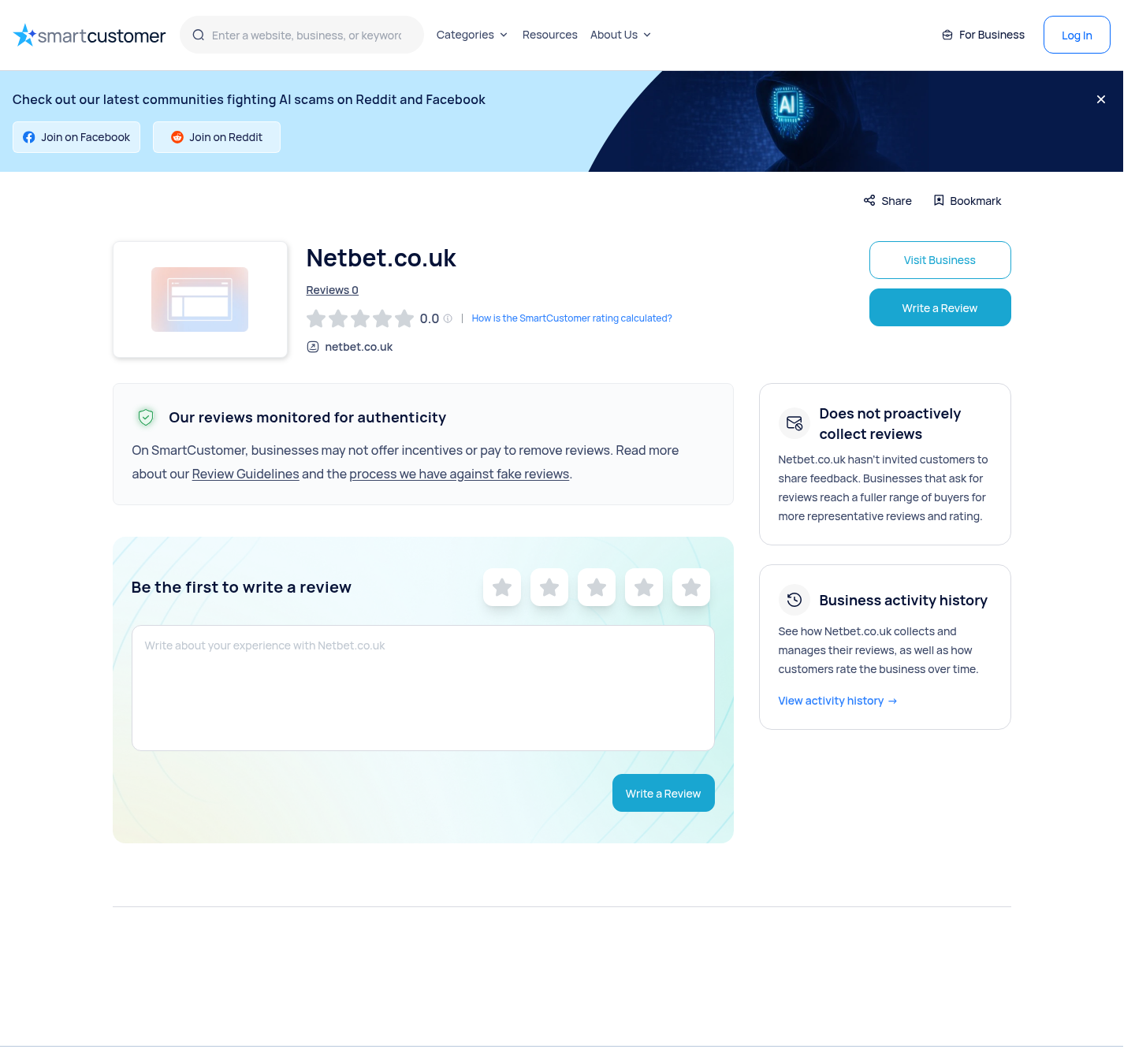
The principal known limitation is scope. Primary evidence supports the exact host and operator record on one date. It does not establish game fairness for a particular round, payment performance, complaint quality, bonus interpretation or future status. No account test, withdrawal test, KYC test or support-response test was supplied.
User reports should generate questions, not automatic verdicts. Where a report concerns delayed funds, seek transaction references and subsequent status. Where it concerns a game, seek round identifiers and history. Where it concerns verification, seek the dated request and acknowledgement. Without those elements, the account remains context rather than corroborated adverse evidence.
Evidence chronology, method and corrections
The chronology is intentionally short. On 20 August 2026, the UKGC register result was checked for the precise host and linked business; the statutory source was checked for legal context; and the independent review listing was captured as user context. No later record is present in the packet.
| Date | Evidence action | Evidential role |
|---|---|---|
| 20 August 2026 | Register result checked for host and operator | Primary support for the green identity signal |
| 20 August 2026 | Gambling Act 2005 source checked | Primary legal context |
| 20 August 2026 | Independent review listing checked | Context only, not a regulatory finding |
The method gives greatest weight to current primary evidence, then keeps operator statements and user reports distinct. The verdict is limited to claims that the accepted records support. Missing expiry, payment, withdrawal, KYC and complaint-outcome facts remain explicitly unknown. More detail on this hierarchy is available in the evidence methodology.
Corrections should identify the exact statement challenged and provide a dated, competent record or an original account document with sensitive information removed. Use the corrections contact for evidence that the host, operator, regulatory status or chronology has changed. A correction request does not itself prove the proposed replacement fact; it creates a reviewable evidence trail.
Readers who have independently verified the exact host, checked current terms and decided that gambling is appropriate for them may See today's checked pick. Gambling involves financial risk; set limits and do not use money needed for essential costs.
Frequently asked questions
Is NetBet legal in the United Kingdom?
The supplied primary record supports the exact host `netbet.co.uk` as linked to Netbet Enterprises Limited under UKGC account 39170, with a current remote record checked on 20 August 2026. That supports a licensed-host conclusion for Great Britain on the check date, not a promise about future status or every account outcome.
Is NetBet a scam?
The current primary evidence does not support calling the verified UK host a scam. The regulator result matches the host and named operator. That conclusion does not extend to lookalike domains, unsolicited messages or cloned interfaces, and it does not decide whether an individual round or withdrawal was handled correctly.
What should I save after a disputed casino round?
Save the round or session ID, game title, exact timestamp and time zone, stake, balance before and after, error text, account-history entry and support reference. Keep originals where possible. A specific event trail is more useful than an undated screenshot or a general description of a frozen game.
Has a NetBet withdrawal been tested here?
No. The packet contains no withdrawal test and no supported claim about payment speed, available methods, fees or limits. Check the live cashier and current terms, then preserve the request reference, displayed status, verification messages and matching receiving-account entry.
Does a KYC request mean the operator is unsafe?
No. A verification request is not by itself evidence of fraud, but its scope and submission channel still matter. Confirm that you are using the exact verified host, ask what requirement each document addresses, retain acknowledgements and never provide passwords, one-time codes or complete payment credentials.
How should I escalate an unresolved complaint?
Send a written complaint tied to exact round, session or transaction references, request a case number, and preserve the response chronology. Then follow the operator’s documented complaint procedure and verify that any named dispute body covers the issue. No specific alternative dispute resolution provider is established by the supplied packet.