William Hill UK evidence dossier: licence and withdrawals
A hypothetical withdrawal file starts with a simple sequence: a player requests £300, receives a request for identity evidence, submits it, and then sees no immediate payment. That sequence alone does not establish a scam, an unfair refusal or even a delay. The useful questions are whether the player used the verified host, what the account status says, which documents were requested, when each step happened and whether the operator issued a final response.
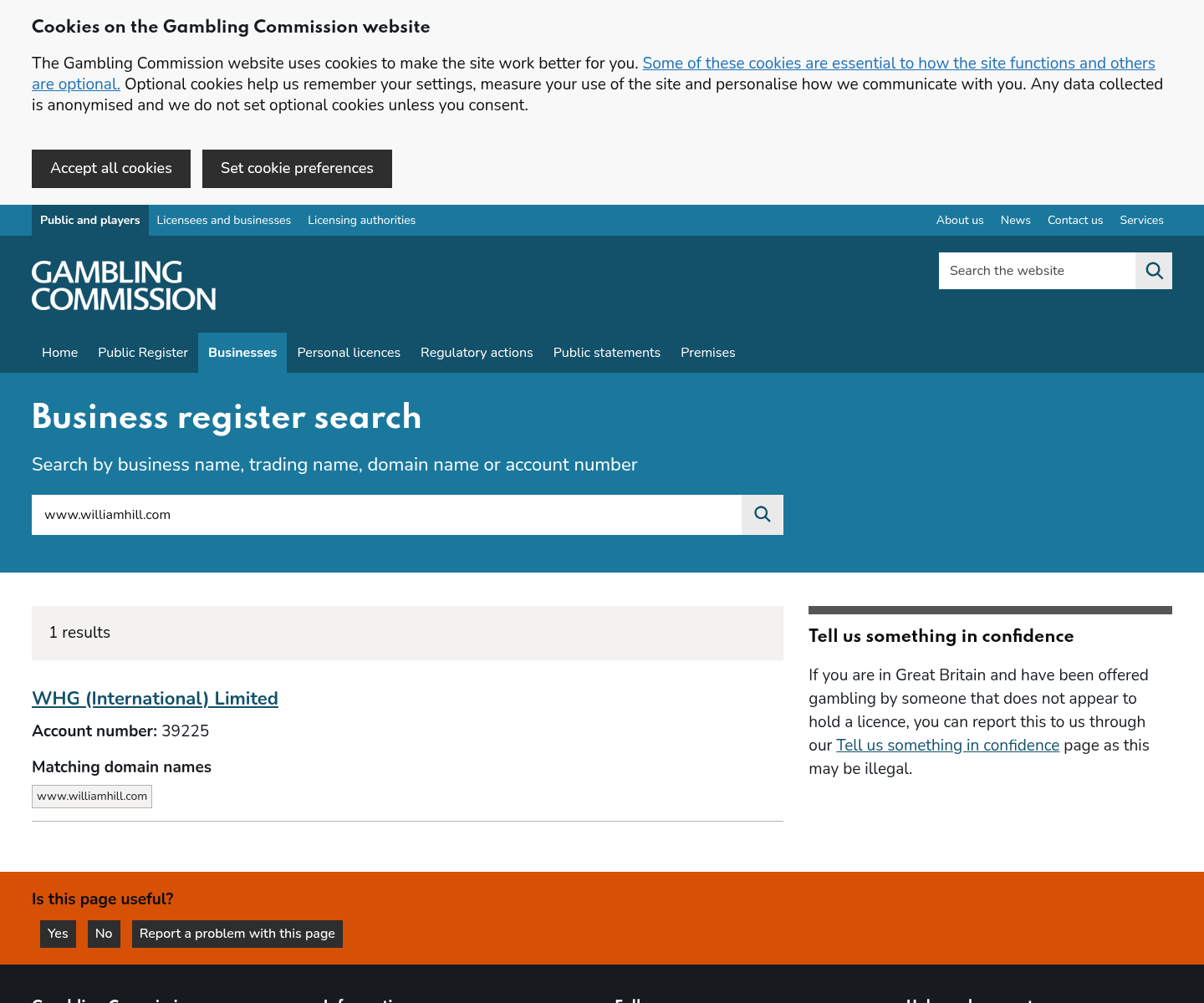
For William Hill, the strongest available evidence is a dated UK Gambling Commission register search connecting www.williamhill.com with WHG (International) Limited. UKGC account 39225 was recorded as current for remote activity when checked on 20 August 2026. That exact host–operator match supports a green signal. It does not predict the outcome or speed of an individual withdrawal.

Withdrawal file: what the evidence can establish
A withdrawal case should be treated as a timeline, not a verdict. Record the request date and amount, the payment route selected, every status shown in the account, each document request, the date of submission and any response reference. Preserve exact wording in screenshots, but redact card numbers, document numbers, addresses and other sensitive data before sharing a complaint file.
No withdrawal test was supplied for this dossier. There is therefore no evidence-led basis for publishing a typical processing time, minimum withdrawal, fee, acceptance rate or claim that one payment method is faster than another. Those points remain unknown until supported by applicable terms, account evidence or a completed documented test.
| Withdrawal-file item | What to record | What it can show |
|---|---|---|
| Request | Amount, date, time and account status | When the process began |
| Verification request | Exact document category and request time | Whether KYC interrupted the withdrawal |
| Submission | File type, submission time and acknowledgement | Whether requested evidence was delivered |
| Operator response | Reference, wording and date | The stated reason or next step |
| Outcome | Paid, cancelled, rejected or unresolved | The result, without guessing at the cause |
A pending status is not proof of wrongdoing. Equally, a licence match should not be used to dismiss a documented payment problem. The case must be assessed on its own dated records.
Evidence checklist and current signal
The green signal is narrow: current primary evidence supports the precise domain and named operator. It is not a general guarantee of safety, solvency, service quality, game outcomes or successful withdrawals. The evidence packet contains one regulatory match, one statutory source and one independent review-platform capture used only for context.
| Question | Evidence available | Finding |
|---|---|---|
| Does the exact host appear in a regulator result? | UKGC search capture dated 20 August 2026 | Yes |
| Is a legal operator named with that host? | UKGC result names WHG (International) Limited | Yes |
| Is a current remote account identified? | Account 39225, checked 20 August 2026 | Yes |
| Is an expiry date supplied? | No | Unknown |
| Was a withdrawal test completed? | No test in the packet | Unknown |
| Do user reports prove licensing or misconduct? | No | Context only |
The underlying register result can be checked in the UK Gambling Commission business search. The capture below preserves the accepted dated record used for the host and operator comparison.
Exact host, operator and licence match
Three identifiers should agree before the licensing signal is relied upon: the hostname in the browser, the legal entity in the regulator result and the regulator account. Here they are www.williamhill.com, WHG (International) Limited and UKGC account 39225. The dated record was described as current for remote activity on 20 August 2026.
That match matters because a familiar name or copied design is not enough. A clone can reproduce colours, wording or a logo while using a different hostname. Begin with the complete host, not merely a brand name in a search result or message. Compare spelling, punctuation and domain ending character by character, then repeat the regulator search independently.
| Identifier | Verified value | Practical check |
|---|---|---|
| Host | www.williamhill.com | Read the full browser hostname before signing in |
| Operator | WHG (International) Limited | Match the legal name to the regulator result |
| Regulatory account | UKGC 39225 | Confirm the account remains current when checking |
| Record date | 20 August 2026 | Treat later changes as requiring a fresh check |
| Expiry date | Not supplied | Do not invent or assume one |
The host–entity match answers the central legitimacy question more reliably than ratings, advertisements or copied licence text. Guidance on repeating the process is available under licence checks.
Scam or legitimate, and legal or not?
On the supplied evidence, the exact checked host has a current primary-regulator match to the named operator, so the appropriate signal is green rather than amber or red. There is no official adverse record in the packet and no corroborated documented evidence supporting a scam finding. Calling the verified host a scam would therefore overstate the evidence.
The legal conclusion must remain equally precise. The UKGC record supports the operator’s current remote regulatory status for the exact host as checked. The Gambling Act 2005 is the principal Great Britain gambling statute in the accepted packet. This does not determine every player-specific issue, transaction dispute, location question or contractual term. A player still needs to meet applicable age, location, identity and account conditions, none of which were individually verified here.
A green licence signal also does not convert every operator statement into an independently established fact. Promotions, payment availability and account rules require their own current evidence. For safer play controls and support routes, use responsible gambling guidance.
Payments and withdrawals: confirmed limits
The packet does not identify supported cards, bank services, wallets, deposit limits, withdrawal thresholds, fees or processing windows. Naming any of them would be speculation. Payment options can also vary by account, location, currency, verification state and current operator policy, so a logo displayed at checkout would not by itself prove eligibility or timing.
Before depositing, capture the payment screen applicable to the account and note any displayed minimum, maximum, fee or restriction. Before withdrawing, check whether the selected route is available for returns and whether the account requests verification. If a payment route changes or disappears, record the date rather than assuming the reason.
| Payment question | Status in this evidence packet | Sensible verification step |
|---|---|---|
| Supported deposit methods | Unknown | Check the authenticated cashier before payment |
| Supported withdrawal methods | Unknown | Check the withdrawal screen for that account |
| Processing times | Unknown | Preserve the displayed estimate and request time |
| Fees and limits | Unknown | Record the applicable cashier wording |
| Completed withdrawal test | None supplied | Do not claim a tested result |
For a structured record of amounts, timestamps and status changes, follow the payment checks. Never send identity documents or payment details to an address obtained from an unsolicited message.
KYC: separating verification from obstruction
A request for know-your-customer evidence can occur around account use or withdrawal, but no brand-specific document list was supplied. It would be unsafe to promise that a passport, driving licence, bank statement or any particular file will always be requested or accepted. Use only the categories and upload route presented within the verified account or confirmed support process.
In the hypothetical £300 file, the useful distinction is between a documented verification step and an unexplained stall. Record what was requested, why the operator says it is needed, the submission deadline if one is shown, the secure channel used and whether receipt was acknowledged. If the same material is requested again, ask which requirement remains unmet rather than repeatedly transmitting sensitive files without clarification.
Documents should be current, legible and limited to what the verified request requires. Do not alter them. Retain redacted copies for the complaint chronology, while keeping unredacted originals out of general email threads or public reviews. If support asks for an unusual transfer, password, one-time code or remote device access, stop and perform the clone checks before proceeding.
Complaint and escalation route
Start with the operator’s documented support or complaint process accessed through the verified host. State the remedy sought, such as an explanation, status update or review of a rejection. Provide the account identifier appropriate to the secure channel, withdrawal amount, request date, document-submission dates and relevant references. Keep the description factual and avoid conclusions that the records cannot establish.
If the matter remains unresolved, request a final response and preserve it with the complete timeline. The packet does not identify a brand-specific alternative dispute resolution provider, complaint deadline or regulator route for an individual case, so none should be guessed. Use the complaints guide to organise the file and determine which escalation information still requires confirmation.
| Escalation stage | Include | Avoid |
|---|---|---|
| Initial complaint | Dates, amount, status and requested remedy | Unsupported accusations |
| Evidence follow-up | Document categories and acknowledgements | Sending secrets through unverified channels |
| Final response request | Complaint reference and unresolved points | Assuming silence proves fraud |
| External escalation | Final response and full chronology | Naming an unverified dispute body |
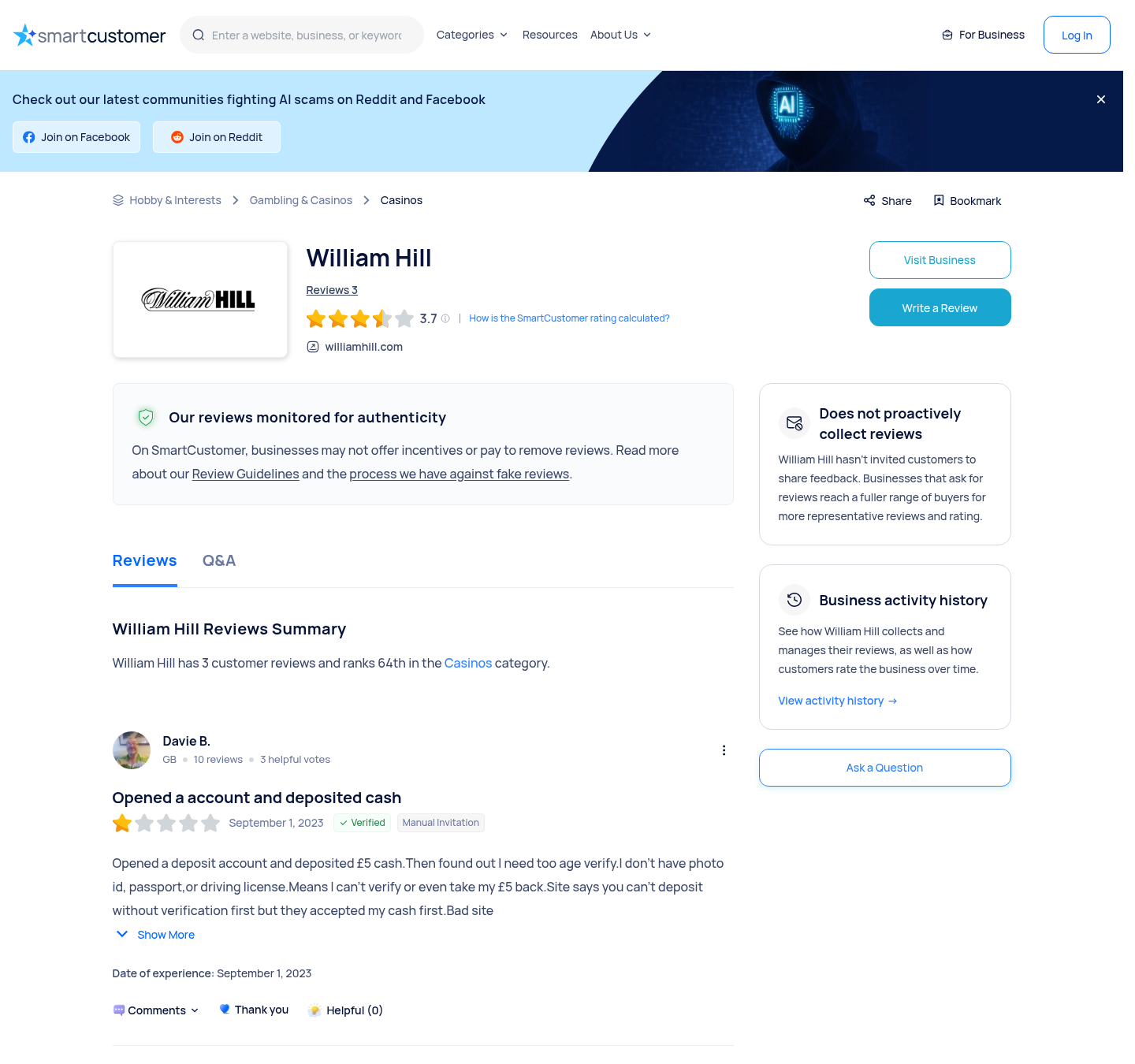
User-review material may suggest questions to investigate, but it cannot decide the complaint. The dated independent review-platform context was checked only as contextual material, not as proof of licensing, safety or any allegation.
Clone checks before login or payment
Treat the hostname as the first control. A message can reproduce the William Hill name while directing to a lookalike address. Do not rely on a logo, page colour, sponsored placement, sender name or a claim that an account must be verified urgently. Navigate by a route already trusted, then compare the browser hostname with www.williamhill.com.
Check for added words, swapped letters, unexpected hyphens, misleading subdomains and a different domain ending. A padlock indicates an encrypted connection; it does not prove that the recipient is the licensed operator. Repeat the legal-entity and account comparison in the regulator record rather than trusting licence wording copied onto a site.
Warning signs include pressure to move a conversation to an unfamiliar channel, requests for a password or one-time code, demands for a separate payment to release a withdrawal, and instructions to install remote-access software. These signs justify stopping and verifying; they do not by themselves establish who sent the message. Further patterns are listed under scam warnings.
The single commercial route is available only after those checks: See today's checked pick. It should not be used as a substitute for confirming current terms, affordability or personal eligibility.
Risks, unknowns and evidence chronology
The principal positive evidence is the dated regulator match. The principal limitation is that the packet does not contain transaction-level testing or current operator terms. Consequently, the dossier cannot rate payout speed, KYC ease, support quality, game range, bonuses, affordability controls or complaint outcomes.
| Date | Evidence event | Evidential role |
|---|---|---|
| 20 August 2026 | UKGC business search checked | Primary support for host, entity and current remote account match |
| 20 August 2026 | Gambling Act 2005 source checked | Primary statutory context for Great Britain |
| 20 August 2026 | Independent review platform checked | User context only; not proof of a claim |
The absence of a supplied licence expiry date means no expiry should be stated. The absence of a withdrawal test means neither success nor failure can be attributed to the service. The absence of a specific complaint record means there is no basis to report a complaint as established fact. A later regulator change, domain change or official adverse record could alter the signal and should trigger a fresh assessment.
Methodology and correction path
The assessment prioritises a competent primary register over operator marketing and user commentary. It matches the exact host to the named legal entity and account, records the check date, then separates established facts from practical questions and unknowns. User-context material is retained only to frame possible lines of enquiry; it cannot create a licence finding or prove misconduct.
The green signal follows from the current primary host–operator match. Red would require an official adverse record or corroborated documented evidence. Where the precise relationship remained unverified, amber would be appropriate. Full assessment principles are set out in the methodology and editorial policy.
Corrections should identify the disputed wording, provide a dated competent source and explain the precise change requested. Transaction complaints should be redacted so that passwords, payment credentials and identity-document numbers are never submitted. Evidence can be sent through the corrections contact. A newer regulator record takes priority over this dated snapshot.
Frequently asked questions
Is William Hill legitimate in the United Kingdom?
The exact checked host, `www.williamhill.com`, appeared in a UK Gambling Commission result set with WHG (International) Limited, and account 39225 was recorded as current for remote activity on 20 August 2026. That supports a green licensing signal for the precise host–operator match. It is not a guarantee of transaction speed or the outcome of an individual dispute.
Is William Hill a scam?
The accepted packet contains no official adverse record or corroborated documented evidence supporting a scam finding. Current primary evidence instead matches the exact host to the named licensed operator. Lookalike domains can still misuse a familiar brand, so the browser hostname and regulator entry should be checked before login or payment.
How long do withdrawals take?
No supported processing time or completed withdrawal test was supplied. Record the request timestamp, displayed status, verification requests and operator responses. Do not treat a pending status alone as proof of misconduct, and do not assume a general timeframe applies to a particular account.
Which payment methods are available?
The evidence packet does not establish any specific deposit or withdrawal method, fee, minimum or maximum. Check the authenticated cashier for the account and preserve the applicable wording before depositing. Availability shown elsewhere may not apply to the player, transaction or verification state.
What should I do if KYC blocks a withdrawal?
Record the exact document category requested, submission date, secure upload route and acknowledgement. Ask which requirement remains unmet if the request repeats. Do not send passwords, one-time codes or identity files through an unverified message, and include the documented chronology in a formal complaint if the issue remains unresolved.
Where should an unresolved complaint go?
Begin with the complaint route reached through the verified host and request a final response if the matter is not resolved. Keep the amount, dates, references, document requests and requested remedy together. No brand-specific dispute provider or deadline was supplied, so confirm those details from competent current information rather than guessing.